Enoch Kids & Youth Bible Lesson PPT Free Download (Genesis 4:17~5:32) · Origin Bible #5
About Origin Bible
Origin Bible is the Bible-education brand of Mission Zedero, which serves in Cambodia. So that Bible stories can be met again in the language of children and youth, we share animation videos and teaching materials (PPT and teacher scripts) free of charge.
The copyright of the videos, PPT, and teacher scripts belongs to Mission Zedero. In churches, children's ministries, and mission fields you may freely use, copy, and share them for non-profit educational purposes, and you may also adapt them to fit your own setting. Commercial sale or paid distribution is not permitted. When you use them, please credit ‘Origin Bible’ as the source.
License: CC BY-NC 4.0
Contact: joypej@gmail.com
the Origin Bible YouTube channel has more Bible-story videos for you to watch.

💡 PowerPoint files are large and may take a while. On a phone, we recommend using Wi-Fi.
💡 PDF files usually download right away without this message.
What this lesson covers
Genesis 4:17 to 5:32. It begins with Cain building a city, meets Enoch, who walked faithfully with God, inside the family line of Genesis 5 where the same sentences come around again and again, and ends with Noah becoming the father of three sons.
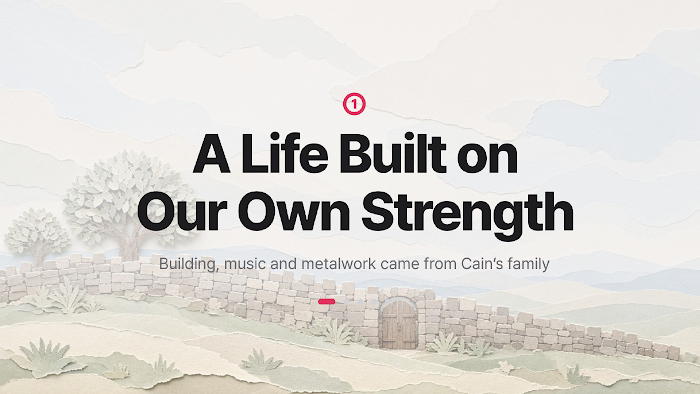
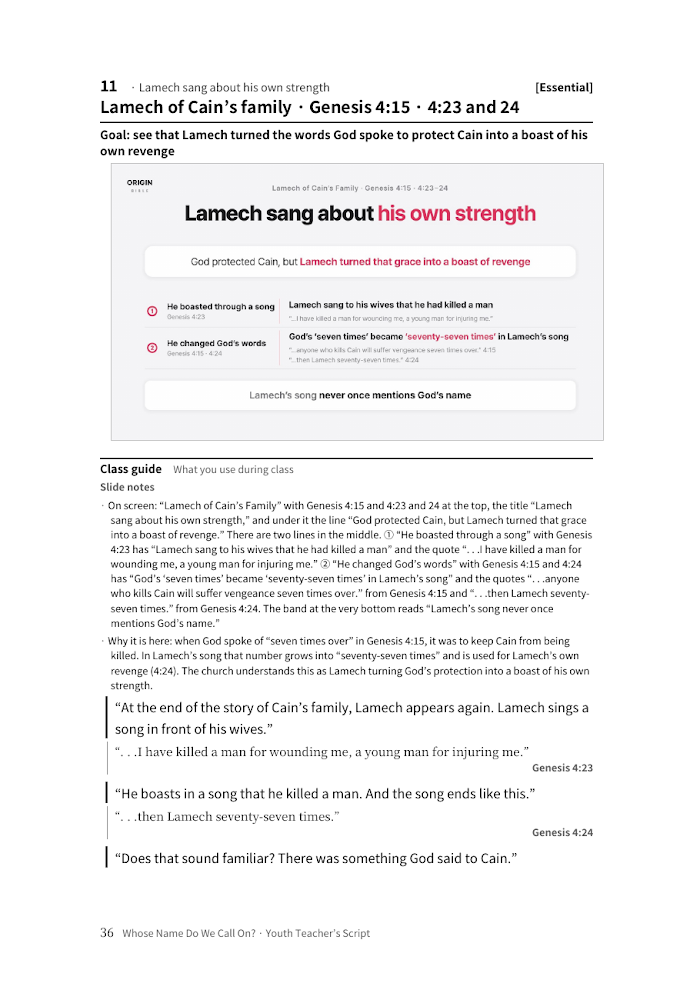
Cain went out from the LORD’s presence and lived in the land of Nod. He built a city and named it after his son. From his family came those who live in tents and raise livestock, those who play the harp and pipe, and those who forge tools out of bronze and iron. Then Lamech sang to his wives about his own strength. In that song the name of God does not appear even once.
Right after that, Genesis 4 ends with these words.
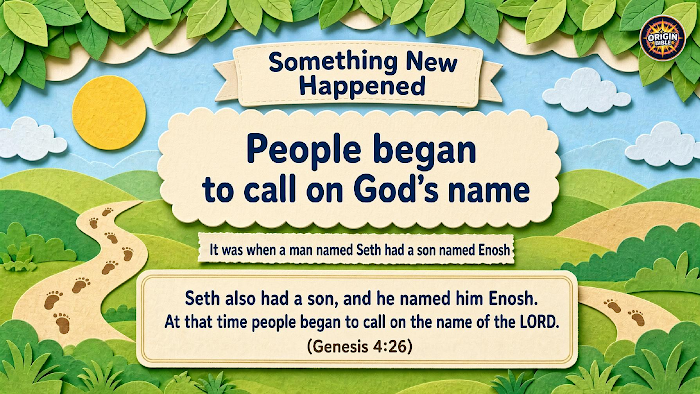
“Seth also had a son, and he named him Enosh. At that time people began to call on the name of the LORD.”
Genesis 4:26
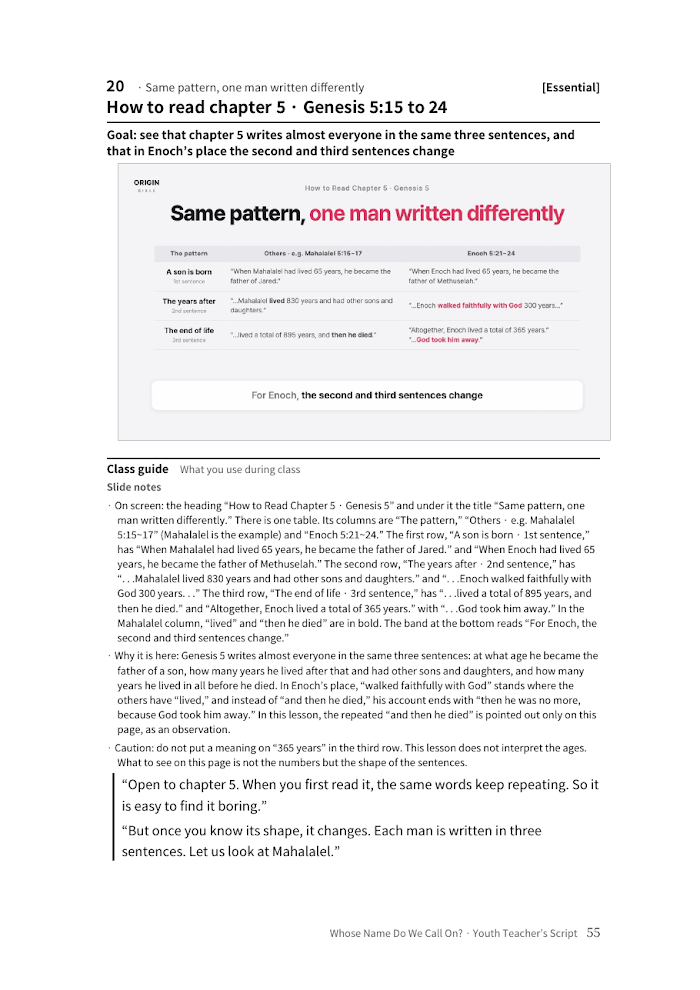
Genesis 5 is the written account of Adam’s family line. Almost everyone is recorded the same way: he became the father of a son, lived so many more years and had other sons and daughters, lived so many years in all, and then he died. Only at one man’s place do the words change.
“Enoch walked faithfully with God; then he was no more, because God took him away.”
Genesis 5:24
The family line goes on to Noah, the grandson of Methuselah. When Noah was born, his father said this son would comfort us in the labor and painful toil of our hands, and Genesis 6:9 records that Noah too walked faithfully with God.
How the session runs
Elementary · 37 slides · “The Walking with God Expedition”
Opening → First path · Things people made → Second path · People who called on God’s name → Third path · People who walked with God → Noah → Jesus → Response
The sentence the elementary lesson is aiming at: “Enoch walked with God. We too call on God’s name and walk with God.” With only the first sentence, Enoch ends up as a great man from long ago; with only the second, it becomes a rule for living with nothing under it. So the children hear both together. The lesson also shows that with the gifts God gave us we can lift up God’s name instead of our own, and that when we do wrong, if we do not brag but confess it to God, we are forgiven because of Jesus.
Youth · 38 slides · “Whose Name Do We Call On?”
Opening → ① A life built on our own strength → ② People who called on the LORD’s name → ③ Enoch, who walked with God → ④ The hope in Noah’s name → ⑤ Whose name do we call on?
The script does not give timings. Every slide is graded essential, recommended or optional, so the teacher who knows the room decides how many to use.
The one sentence the lesson is aiming at: “Rather than making a name for myself, I will call on God’s name as I walk.” “Rather than making a name for myself” comes from Genesis 4:17, where Cain built a city and gave it his son’s name. “I will call on God’s name” comes from 4:26, and “as I walk” from the walk of Enoch and Noah (5:22 and 24, 6:9). The first part alone becomes a lecture that says “do not be greedy.” The second part alone becomes a promise that does not know what it is turning away from.
There are four key points. Whose name was at the center of a life built on its own strength. Genesis 4 ends with people calling on the name of the LORD. Enoch walked with God for 300 years. What saves a person is not the family they were born into but God’s grace.
What the teacher should know first
The text does not call these skills bad.
Tents, instruments and iron are not judged in Genesis 4. Psalm 150 tells us to praise God with the harp and the pipe, the very instruments named in Jubal’s story. This lesson is not a place to scold students for what they build. It is a place to ask whose name is at the center of it.
Genesis 4:26 says “people.”
It is easy to tie the people who called on the name to “Seth’s family,” but the NIV says “At that time people,” and the text does not name a family. Nor is it the first time anyone prayed. Before that, Cain and Abel had already brought offerings to the LORD.
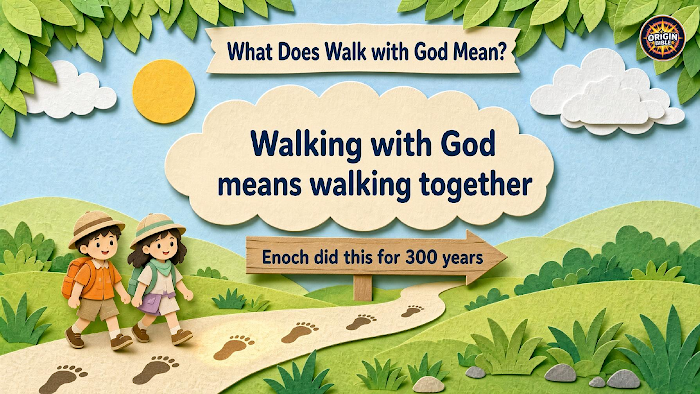
To walk with God is to walk together with him.
It is not one special experience but a life that went on for 300 years. Hebrews 11:5 describes the same life with the words “one who pleased God.” Hebrews follows the Septuagint (the Greek Old Testament), so the wording looks different, but it is one man’s life told in two ways.
The text stops at “God took him away.”
Genesis says only that God took Enoch away. It does not say where or how, and the script asks teachers to stop there too. The same Hebrew word is used of Elijah in 2 Kings 2:3 and in Psalm 73:24 (“you will take me into glory”).
From the script’s list of common mistakes
saying the music and skills of Cain’s family should be avoided · saying the people who called on the name at 4:26 were Seth’s family · saying 4:26 is the first time people prayed · saying Enoch changed after he became the father of Methuselah · finding a hidden meaning in Enoch’s age or Methuselah’s name · equating Enoch with the rapture at the end of time. The script also lists wording never to use in class, such as adding stories about Enoch that are not in the Bible or splitting people into two bloodlines.
Questions students actually ask
Did Enoch go to heaven?
Genesis says only that God took Enoch away. It does not say where or how. The script’s answer: “Let’s say it just as the Bible says it: God took him away.”
If music and tools came from Cain’s family, are they bad?
No. Genesis 4 does not call tents, music or metalwork bad. With the same harp and pipe, the Psalms tell us to praise God.
Did they really live 900 years?
The Bible records the numbers as they are, but it does not explain how people lived so long. The lesson shows that even Methuselah, who lived longest, ends with “and then he died,” and brings the class back from how long a person lived to whom he walked with.
What do I have to do to walk with God?
The Bible does not say what Enoch did as he walked with God. The practices at the end of the lesson (a short prayer that opens the day, telling God about a worry first) are introduced not as a method the Bible prescribes but as steps we try.
What if I grew up in a Christian family?
Growing up in a Christian family is a great gift, but that faith does not become yours on its own. The script reads John 1:12 and says, “Now you call on that name yourself.”
The script also keeps a list of what the Bible does not tell us
who Cain’s wife was · whether Lamech really killed a man · where Enoch is now. Each stops at “the Bible does not tell us,” and where the Bible leaves a gap, we leave it too.
Children’s Ministry (Elementary) Materials
Class slides in an ‘Explorers’ format tailored to elementary-age children. (Preview)
 |  |
 |  |
 |  |
 |  |
The PowerPoint file includes the video, so it is large (about 180MB). If you do not need the video, download the PDF.
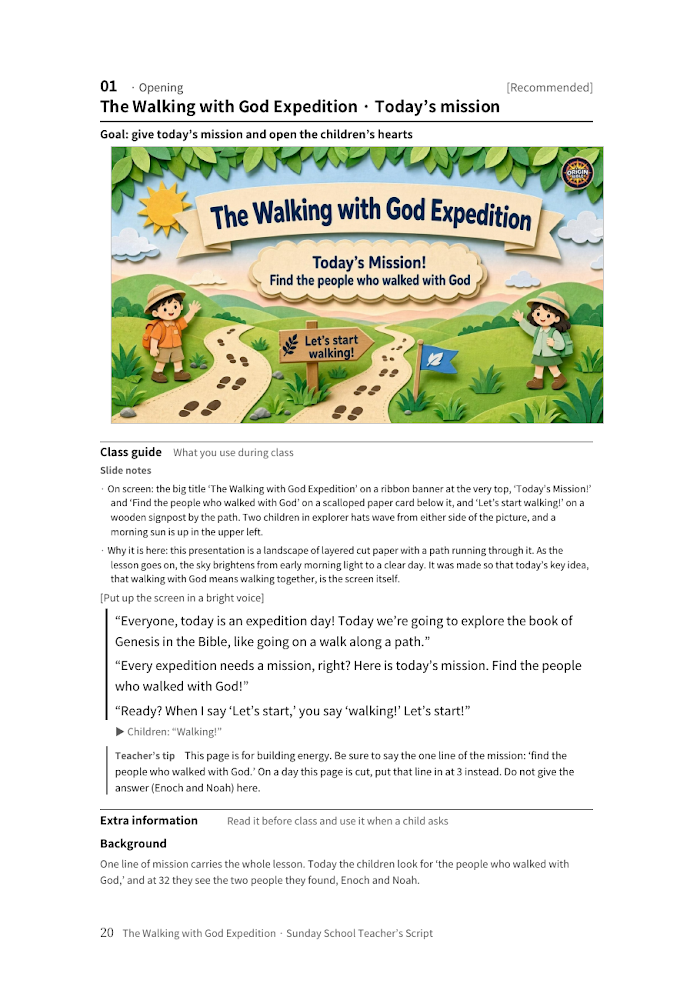
Material to help teachers as they lead the Bible study using the PPT. It includes everything needed: a Bible-study guide, slide-by-slide commentary, and reference material. (Preview)
 |  |
 |  |
 |  |
Youth (Middle & High School) Materials
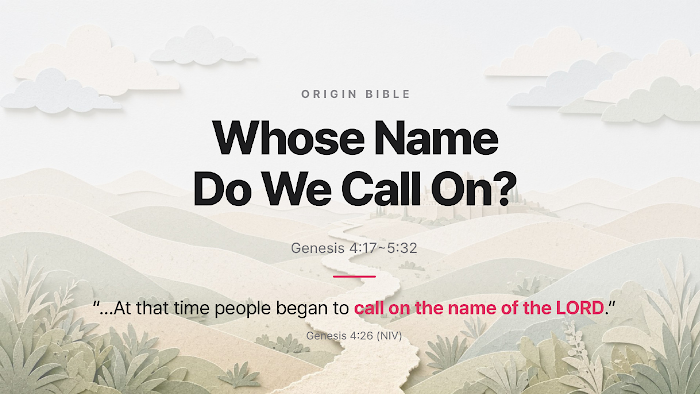
Class slides tailored to teenage students. (Preview)
 |  |
 |  |
 |  |
 |  |
The PowerPoint file includes the video, so it is large (about 92MB). If you do not need the video, download the PDF.
A teacher script that leads all the way to discussion and application. (Preview)
 |  |
 |  |
 |  |


Comments
Post a Comment