Genesis Deeper ③ The Day Dry Land Appeared — why did plants come before the sun? (Genesis 1:9–13)
A series that takes one Bible passage at a time and looks a little deeper. Every post comes with images you are free to use in worship, class, or on social media.
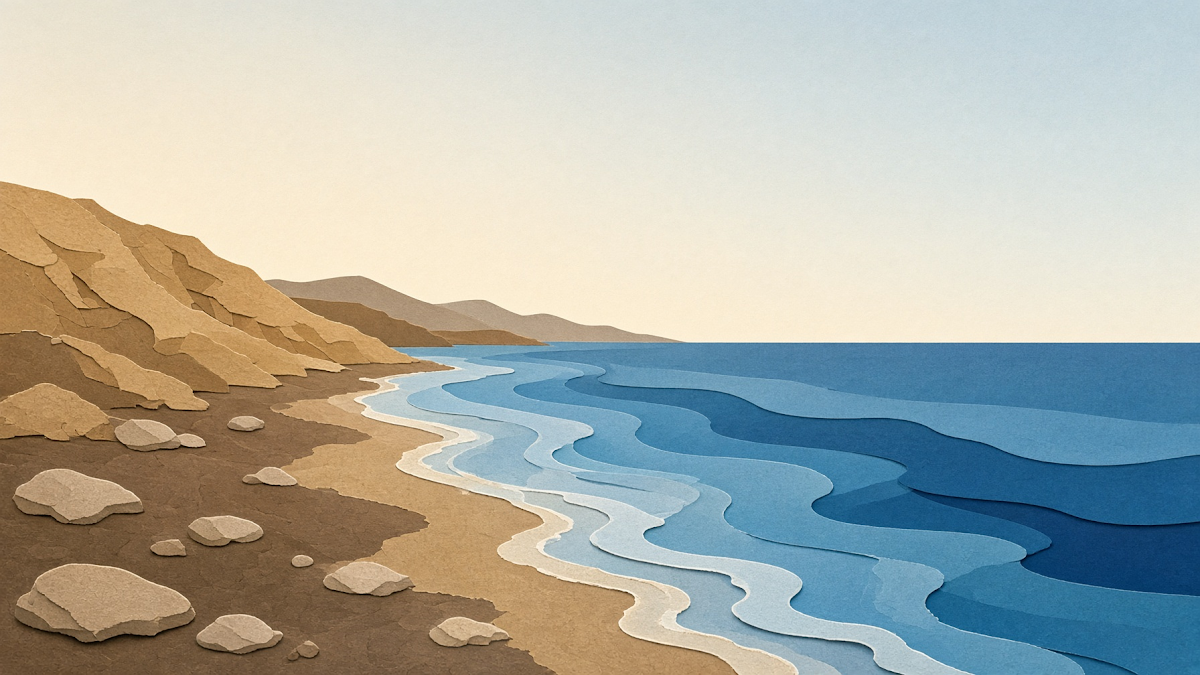
God said, “Let the waters under the sky be gathered together to one place, and let the dry land appear”; and it was so. God called the dry land “earth”, and the gathering together of the waters he called “seas”. God saw that it was good. God said, “Let the earth yield grass, herbs yielding seeds, and fruit trees bearing fruit after their kind, with their seeds in it, on the earth”; and it was so. The earth yielded grass, herbs yielding seed after their kind, and trees bearing fruit, with their seeds in it, after their kind; and God saw that it was good. There was evening and there was morning, a third day.
— Genesis 1:9–13 (World English Bible, public domain)
1. The sky had opened, but there was nowhere to stand

Where day two ended, there is a sky. A space had opened between the waters above and the waters below, and God gave that space the name “sky.” But look down and it is still water. There is not a hand’s width of ground to stand on.
Day three deals with those lower waters. And God does not remove the water. He gathers it to one place instead. The water does not disappear — it simply moves aside. And in the place it vacates, dry ground appears.
In other creation stories of the ancient Near East this moment is usually a battle: a god kills the sea monster and builds the world out of its body. Genesis has no such fight. At one word, the water quietly gives up its place.
2. The water withdraws, and the earth brings forth
Two things happen on day three. God speaks twice, and “it was good” is said twice. Among the first three days, only day three is like that.
The first is making a place. When the waters gathered to one place, dry land appeared. God called the dry land “earth” and the gathered waters “seas.” To be given a name is to have received a place of one’s own.
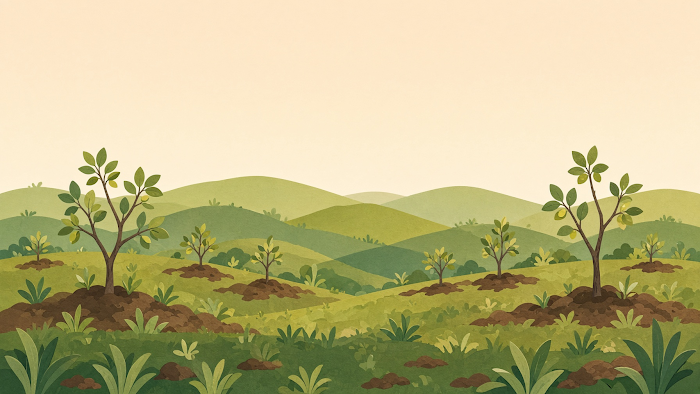
The second is filling that place — and here the wording is a little unexpected. The text does not say God planted anything. He tells the earth to yield. The next verse follows the same way: “The earth yielded … trees bearing fruit.” The one commanded is the earth, and the one that produced is the earth. This is the first scene in Genesis 1 where the work of bringing something forth is handed to a creature.
3. Going deeper — why plants came before the sun

Read day three to children and one question almost always comes. “How did plants grow if there was no sun yet?” The sun, moon and stars arrive the following day, on day four (Genesis 1:14–19).
The Bible does not answer that question. Genesis 1 never explains what the plants lived on. Where Scripture does not speak, we do well to stop too.
What we can see is how Genesis 1 is put together. Lay the six days out in two sets of three and they pair up.
Day 1 light ↔ Day 4 sun, moon, stars
Day 2 sky and waters ↔ Day 5 birds and fish
Day 3 dry land and plants ↔ Day 6 animals and people
The first three days prepare places; the last three fill them. Genesis 1:2 described the starting state as “formless and empty”. The first three days answer the formlessness, the last three answer the emptiness.
Plants sit on day three for the same reason. Genesis 1 treats grass and trees not as business of the sky but as business of the ground. So day three became the only one of the first three days that also finished the filling, and many scholars read the doubled “it was good” — twice on this day alone, among those three — as belonging to that.
What Genesis 1 follows is the making of a world fit to live in. This world is not something that happened by accident; it is a place God prepared to be lived in.
4. Tadshe deshe — let the earth grass grass

“Be gathered together” in verse 9 is yiqqawu (יִקָּווּ) in Hebrew — scattered things drawing to one place. In verse 10 that same root comes back as a noun: the word behind “the gathering together of the waters” is miqweh (מִקְוֵה), “a gathering.” The verb of the command returns as the word for its result.
Verse 11 is better still to the ear. In “let the earth yield grass,” the verb is tadshe (תַּדְשֵׁא) and its object ‘grass’ is deshe (דֶּשֶׁא) — a matched pair from one root. Forced into English it is something like “let the earth grass grass.” Verb and object chime on the same sound, letting you hear the word becoming the thing.
“After their kind” is leminó (לְמִינוֹ) and leminéhu (לְמִינֵהוּ), two forms of one word. Look closely and verse 11 differs from verse 12: in verse 11 the phrase attaches only to the trees, while in verse 12 it attaches to both the herbs and the trees. The English above carries that difference through. The answer comes back finer-grained than the command.
5. A third day
Day three closes exactly as the two days before it: “There was evening and there was morning, a third day.” Twice the work, and the same closing line. A fuller day does not become a longer one. God counted that day as one day, like the others.
6. For us today
What stands out on day three is rather what God did not do. He could have planted the grass Himself, set each tree in place Himself. Instead He told the earth to yield — and put the seed inside the fruit. The text says it plainly: fruit “with their seeds in it.”
A seed is not stuck on from outside. It is already within. Split one piece of fruit open and the next tree is sitting there.
God works the same way with us. Rather than laying results on us from outside, He puts something within us and brings it out through us. Which is why it takes time. There are seasons of planting and waiting where nothing seems to be happening at all.
In such a season, remember this. The water had to withdraw before the dry land appeared. A place had to open first before anything could grow on it. If something in your life is being emptied right now, that does not mean it is over.
“God who prepares a place, gather the waters in me as You gathered them to reveal the land. Rather than straining to manufacture fruit of my own, let me trust the seed You have placed in me and wait. Even when nothing seems to be growing today, I trust that You are at work. Amen.”
🕊 Using this in ministry
Opening question
“If the whole world were covered in water, what couldn’t live?” Let them name grass, trees, ants, our own feet — then move on with “so where should the water go?”
Activity
Pour a little water into a wide tray and put the water-only image on screen. Saying “let the waters be gathered together and let the dry land appear,” tilt the tray so the water runs to one side, point at the bare floor of the tray, and switch to the dry-land image. Make the point: “it wasn’t removed, it was gathered.”
Application
Put the fruit image on screen and cut open a piece of fruit you brought. “Where was the next tree?” When they find the seeds, close with “God has put a seed inside us too.”
⬇ Today’s four images — free to download
 Before there was dry land |
 Gathered to one place |
 Let the earth yield |
 With their seeds in it |
📄 Image licence CC0 (Public Domain) · Use, modify and redistribute freely, no attribution required.
🤖 These images were created with AI (Grok).
🎨 Week 1 Creation — 28 free images — transparent PNG · CC0, day one through day seven
🇰🇷 한국어 · 🇺🇸 English (current) · 🇰🇭 ភាសាខ្មែរ
Origin Bible · Mission Zedero
Contact joypej@gmail.com
✍️ This article was written with the help of AI and reviewed by a person.
Article text is CC BY-NC 4.0 — free for non-commercial use with attribution.


댓글
댓글 쓰기