Cain and Abel Kids & Youth Bible Lesson PPT Free Download (Genesis 4:1~26) · Origin Bible #4
About Origin Bible
Origin Bible is the Bible-education brand of Mission Zedero, which serves in Cambodia. So that Bible stories can be met again in the language of children and youth, we share animation videos and teaching materials (PPT and teacher scripts) free of charge.
The copyright of the videos, PPT, and teacher scripts belongs to Mission Zedero. In churches, children's ministries, and mission fields you may freely use, copy, and share them for non-profit educational purposes, and you may also adapt them to fit your own setting. Commercial sale or paid distribution is not permitted. When you use them, please credit ‘Origin Bible’ as the source.
License: CC BY-NC 4.0
Contact: joypej@gmail.com
the Origin Bible YouTube channel has more Bible-story videos for you to watch.

💡 PowerPoint files are large and may take a while. On a phone, we recommend using Wi-Fi.
💡 PDF files usually download right away without this message.
What this lesson covers
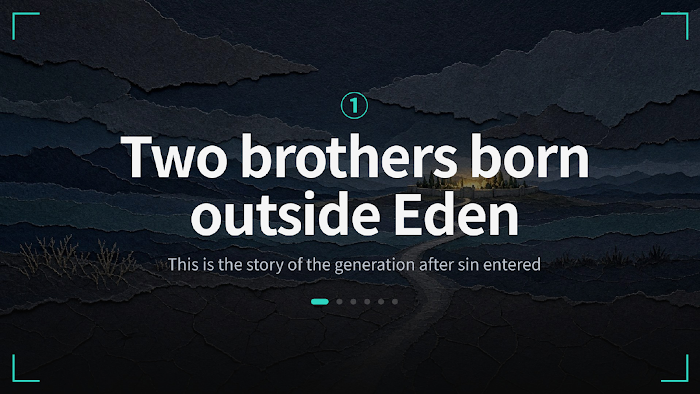
Genesis 4:1 to 16, plus verses 25 and 26. The gate of Eden has closed, and outside the garden the first two brothers are born: Cain and Abel.
Cain works the soil and Abel keeps flocks. In the course of time each brings what he has to the LORD. Cain brings some of the fruits of the soil, and Abel brings fat portions from some of the firstborn of his flock. The LORD looks with favor on Abel and his offering, but not on Cain and his offering.
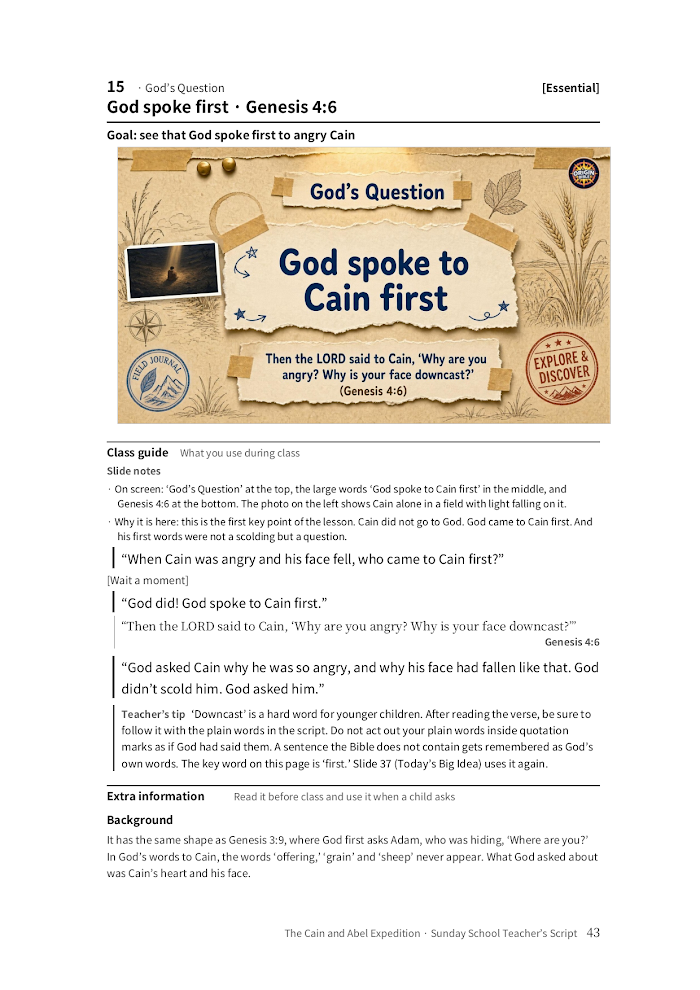
When Cain is very angry and his face is downcast, the LORD comes to Cain first and speaks to him. The heart of this lesson is right here.
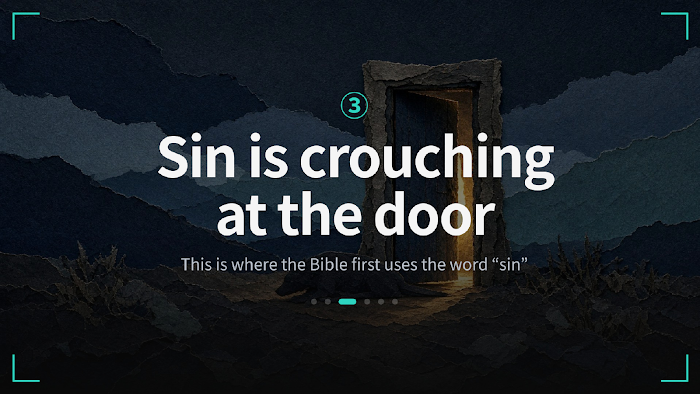
“If you do what is right, will you not be accepted? But if you do not do what is right, sin is crouching at your door; it desires to have you, but you must rule over it.”
Genesis 4:7
But Cain gives no answer, and out in the field he kills his brother Abel. The LORD asks again: “Where is your brother Abel?” In chapter 3 God called to the hiding Adam, “Where are you?” Now he asks the older brother where the younger one is.
Cain is punished and becomes a wanderer, yet God puts a mark on him so that no one will kill him. The story does not stop there. Chapter 4 goes on to the births of Seth and Enosh and closes with this line: “At that time people began to call on the name of the LORD.”
How the session runs
Elementary · 40 slides · “The Cain and Abel Expedition”
Opening → ① Two brothers → ② The moment things changed → ③ At the door → ④ In the field, and after → ⑤ A new beginning → Response
The sentence the elementary lesson is aiming at: “God came first and told Cain to rule over sin. And even where we fall, God keeps us.” With only the first half it becomes homework (“Don’t get angry, and do well”); with only the second it sounds like “It’s fine to do wrong.” So the children hear both together. The slides deliberately do not raise the question “Why didn’t God accept it?”
Youth · 44 slides
Opening → ① Two brothers born outside Eden → ② Both brought an offering to the LORD → ③ Sin is crouching at the door → ④ When Cain did not rule over sin → ⑤ Even so, this is not the end → ⑥ What will we do?
The script does not give timings. Every slide is graded essential, recommended or optional, so the teacher who knows the room decides how many to use.
The one sentence the lesson is aiming at: “God tells me, too, that I can rule over sin. And even where I have fallen, he keeps watch over me.” The first half comes from Genesis 4:7 and the second half from 4:15. The first half alone becomes a lecture that says “just hold it in harder.” The second half alone ends in the comfort of “he will protect me anyway.” So the script asks teachers to let students hear both together.
There are four key points. Genesis 4 does not record why Cain was not accepted. God came first to the very person he did not accept. Sin is at the door, and you can rule over it. Even where we have fallen, God keeps watch over us.
What the teacher should know first
The text does not give the reason. The part where the offerings are brought and the outcomes split is three verses (3 to 5); what follows is eleven (6 to 16). Counted in Hebrew words, that is twenty-eight against one hundred twenty. Many classrooms spend most of the lesson on the three verses, but the weight of the text sits in the eleven.
minchah (gift, offering)
The text uses the same word for what both brothers brought. There is no word for blood on Abel’s side either; there are “fat portions.” The only blood in Genesis 4 is Abel’s own, after he is killed.
sha’ah (to turn one’s eyes toward, to gaze)
This is the verb behind “looked with favor.” It is not a technical term for accepting a sacrifice, and Genesis 4 says nothing about fire coming down from heaven.
chatta’t (sin)
Genesis 4:7 is the first place in the Bible where this word appears, and that first appearance is a warning, not a verdict. The word beside it, robets (crouching), pictures an animal lying low.
ot (mark, sign)
The text does not say what Cain’s mark looked like. It gives only its purpose: so that no one would kill him. It was not a brand of the curse, and the text does not say he was forgiven either.
From the script’s list of common mistakes
saying Cain was not accepted because his offering had no blood · saying Cain gave carelessly · saying fire came down and burned only Abel’s offering · calling the mark a brand of the curse · saying the mark means Cain was forgiven · saying jealousy led to murder (the word jealousy is not in Genesis 4). The script also lists wording never to use in class, such as “the seed of Cain and the seed of Abel” or “are you a Cain or an Abel?”, because it splits people into two groups.
Questions students actually ask
Why did God not accept Cain’s offering?
Genesis 4 does not record the reason. Instead it records at length what God did for Cain next. Because Hebrews 11:4 speaks of Abel’s faith, the church has long found the difference there, and the script asks teachers to keep that apart from what Genesis 4 itself says.
Is being angry a sin too?
The text records that Cain was very angry and that God asked him about it. It does not call the anger itself sin. The script’s answer: “Being angry is standing at the door. Opening the door is the problem.”
Who was Cain’s wife?
The Bible does not give her name. Genesis 5:4 says Adam had other sons and daughters. If the question pulls the class toward timeline debates, the script brings it back to Cain’s fear and God’s mark.
I feel like Cain. I am not accepted either.
The script says to listen first, before giving the lesson’s answer, and then to say: “When you feel like Cain, remember what God did for Cain.”
The script also keeps a table of questions the passage does not answer
how Cain knew he was not accepted · what Cain said to Abel · whether Cain went to heaven in the end. Each is answered with “the Bible does not tell us,” plus one line on why there is no answer.
Children's Ministry (Elementary) Materials
Class slides in an ‘Explorers’ format tailored to elementary-age children. (Preview)
 |  |
 |  |
 |  |
 |  |
The PowerPoint file includes the video, so it is large (about 210MB). If you do not need the video, download the PDF.
Material to help teachers as they lead the Bible study using the PPT. It includes everything needed: a Bible-study guide, slide-by-slide commentary, and reference material. (Preview)
 |  |
 |  |
 |  |
Youth (Middle & High School) Materials
Class slides tailored to teenage students. (Preview)
 |  |
 |  |
 |  |
 |  |
The PowerPoint file includes the video, so it is large (about 110MB). If you do not need the video, download the PDF.
A teacher script that leads all the way to discussion and application. (Preview)
 |  |
 |  |
 |  |


Comments
Post a Comment